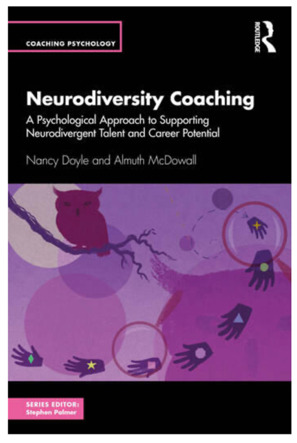

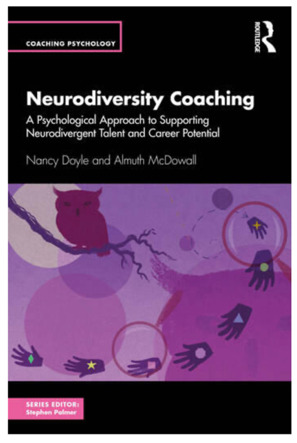
Nancy Doyle and Almuth McDowell
Abingdon: Routledge, 2024
299 Pages. Paperback £28.99; $35.95
ISBN-13: 978-1033436524
Reviewed by Petra Walker, AFBPsS, CPsychol
There has been a plethora of small publications on coaching ADHD or Autism in the last few years, and some mainstream coaching books have dedicated a chapter to coaching clients who are neurodiverse, but none have piqued my interest enough to go out and buy them until Doyle and McDowell published their jointly authored book in December 2023.
As well as both authors being Occupational Psychologists, which was an early indication that this book would be evidence-based, they are also researchers and practitioners who are very aware of that tricky boundary between coaching and therapy. The book has been written for us to dip into to be more widely informed in our practice, not to become qualified neurodiversity coaches. The authors very clearly state early on that reading this book will not qualify a coach to designate themselves as a neurodiversity coach; the aim is to facilitate coaches, managers and community leaders to better support their neurodiverse employees, populations and clients.
With the CDC (2022) estimating that there are around 1.2 billion neurodiverse people in the global workforce, and numerous studies outlining the difficulties faced by those in work, including lower self-esteem and increased stress and overwhelm, I believe that this book has a very clear connection to workplace wellbeing for many of our clients. The authors state on the first page that they are setting out to ‘demystify the themes and assumptions affecting neurodivergent coachee experiences at work’ and to explore ‘the necessary safeguards required for working with this vulnerable group.’
To do so, the book begins by defining neurodiversity and outlining the topics that commonly arise in neurodiversity coaching. When reading these chapters and keeping the knowledge that I am not a diagnostic expert in mind, I started to notice several parallels with clients I have worked with over the past few years, a few of whom have announced halfway through coaching that they have just received a diagnosis for ADHD and that I should know about this. While I have taken this on board as a factor to consider when proceeding, until now, I have not really known how to incorporate it.
Nancy and Almuth have used short case studies throughout the book to illustrate the points made in the chapters. These help the reader understand the often subtle difficulties our clients might face. As with many books published by Routledge, each chapter includes an excellent reference list, conclusion and reflective questions. Very helpfully, this book also includes a Glossary of Terms in an Appendix at the end, which the authors suggest the reader print off to have handy while reading.
SECTION A: SETTING THE SCENE
The book is divided into three parts; the first comprises four chapters that cover definitions, challenges, and the potential neurodiversity can bring to the individual being coached. As a positive psychology coach, this focus on harnessing the neurodiverse client’s potential early on allowed me to reframe my outlook from differences and difficulties to the opportunities and strengths of my current and future clients. The cases used to illustrate the authors’ points in each chapter become real to the reader as stories about each client are interwoven throughout the book, building and illustrating the themes that emerge in each chapter.
SECTION B: COACHING TECHNIQUE AND PRINCIPLES
The second part looks at key coaching techniques and principles of coaching the neurodiverse client. These chapters are not designed to create experts in each technique, but to whet the coach’s appetite to find out more. The authors discuss the use of clean language, transactional analysis, and appreciative inquiry as just three coaching methods that might be appropriate for neurodiverse clients. The four chapters in this section really do fulfil the ‘dip into’ nature of this book, each with good reflective questions for the coach to discuss in supervision or with peers.
SECTION C: CONTEXT MATTERS
Finally, the third part of the book examines the coaching context: Chapter 9 digs into what good looks like for the coachee, both in their performance and in the workplace environment. This was the section of the book where, as coaches, we must remember that we are coaches, not consultants. We can coach our clients around navigating the challenges they face in the workplace, or even a manager around making adjustments for a neurodiverse employee, but we must remember that reading this chapter, with its useful checklists, does not make us experts here. They are good resources for asking pertinent questions, but the coachee and the company need to ensure they are up to date on legislation and options.
Chapter 10 falls clearly within the realm of Positive Psychology Coaching, with a focus on Wellbeing and Work-Life Balance. It touches on burnout, overwhelm, the need for a holistic overview of the client in context, and restoration and recovery.
The last two chapters are ones every coach should read – covering Contracting in Chapter 11 and Reflective Practice in Chapter 12. Almuth and Doyle quote Newton & Napper (2010) at the start of Chapter 11, stating, “Time spent on good contracting is never wasted, although it can be time consuming” (p. 174). Reading this chapter prompted me to reflect on some of the challenges a couple of my supervision clients have faced when coaching neurodiverse clients, including clarifying what constitutes an acceptable level of contact between sessions, addressing assumptions about implied behaviours (such as arriving on time for sessions), and accommodating clients who prefer to keep their cameras off during online coaching sessions. Clear, precise contracting and recontracting, approached with a curious, open mind and a little more time, might have resolved some of these challenges earlier. The topic of safeguarding and legislation is also covered here, albeit lightly, as the rules and laws vary across countries.
Finally, Chapter 12 covers reflective practice and the need for the coach working with neurodiverse clients to have access to supervision or a peer support group of coaches. It discusses Restorative Supervision and the need to contract for the end of coaching at the beginning, so the client experiences a positive end to coaching. Reading these two chapters, I could see how I might tighten my own contracting with all clients, focus on the end of coaching at the start and read more deeply around the concept of supervision for restoration.
CONCLUSION
So, does the book achieve what it sets out to do? I believe it does. The illustrative case studies throughout the book allow the reader, whether they are a coach, manager or community leader, to hear the voice of the neurodivergent client, and the evidence-based models and explanations simplify and clarify quite complicated topics, while providing tools to use. It has certainly earned its place on my bookshelf.
BOOK REVIEWER

Petra Walker is the founder of Petra Walker Coaching and Supervision, which offers positive psychology coaching, leadership coaching and coach supervision. She is a Chartered Coaching Psychologist, an EMCC Senior Practitioner and is accredited as PCC by the ICF.