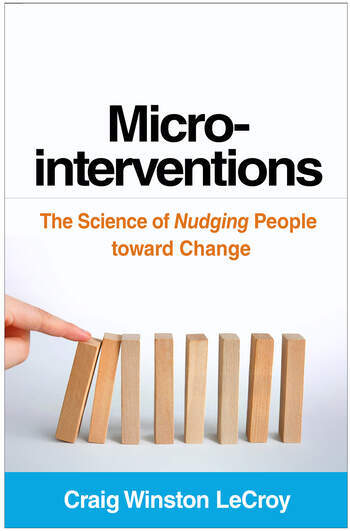

Craig Winston LeCroy
Guilford Press, 2026
266 Pages. Paperback $42.00
ISBN 9781462563739
Reviewed by Sanna Välttilä-Wit (MSc, CAPPC, EIA Sr. Practitioner, PCC, MCS)
We tend to picture change as dramatic: a turning point, a breakthrough, a fresh start. In Micro-interventions, The Science of Nudging People toward Change, Craig Winston LeCroy argues that real change is usually quieter. It unfolds in small moments of hesitation, reappraisal, and shifts in thought or behaviour, and, as he puts it, “change doesn’t always announce itself; sometimes it becomes visible only in hindsight” (LeCroy, 2026).
The author argues that researchers and practitioners have too often focused on the big changes people need to make, overlooking the potential of small ones. Microinterventions, he suggests, can nudge people toward more significant change, and he asks what can be accomplished with small steps.
A Professor Emeritus of Social Work at Arizona State University and Clinical Professor of Pediatrics at the University of Arizona College of Medicine, he combines academic and applied experience. This includes creating the Healthy Families Parenting Inventory, a tool for measuring change over time, and the Go Grrls program, which supports healthy psychosocial development in adolescent girls.
The book’s tone is practical and grounded in a solid academic foundation, evident in its use of research on willpower (Baumeister et al., 1998), self-efficacy (Bandura, 1997), and habits (Duhigg, 2012), among others. It also addresses less-explored topics related to change, including the roles of psychedelics, artificial intelligence, and relationships in the change process. Readers do not need a research background to follow the argument, making the book accessible to a wide professional audience, while the references offer a good starting point for those who want to go deeper.
The book is written for clinicians, coaches, and other helping professionals who want to explore the dimensions of change and learn about microinterventions. From a practitioner’s perspective, the book’s most useful features are its case studies and tables of microinterventions, which translate the concepts in each chapter into concrete options practitioners can try. A glossary at the end helps readers keep track of terminology.
As a positive psychology coach who helps clients make meaningful change, I have long been drawn to a question I first explored in my master’s dissertation: why do we so often fail to do what we know is good for us? My clients don’t know what they need to do; they don’t know how to bridge the implementation gap. My coaching philosophy echoes a line often attributed to Zeno of Citium: “Well-being is realized by small steps, but is truly no small thing.” I approached this book hoping to find evidence that small steps can carry people across that gap, along with practical microinterventions to help clients take them.
THE CASE FOR MICROINTERVENTIONS (CHAPTER 1)
Chapter 1 presents microinterventions as an additional tool for mental health practitioners, arguing that psychotherapy, as currently practiced, can be overwhelming for some clients. It notes that we often do not know what contributed to a person’s change, how much change is enough to make a difference, or what that difference even looks like. Readers are invited to examine change from an interdisciplinary perspective, asking what nudge theory (Thaler & Sunstein, 2008) in behavioural economics, as well as social psychology and philosophy, can teach us about how people change. The chapter left me reflecting on how complex change is and eager to hear more about how microinterventions can influence the process of change.
AWARENESS, MOTIVATION, AND GOALS (CHAPTERS 2 TO 4)
The next three chapters guide the reader from noticing change to wanting it to planning it. Chapter 2 explains why awareness is key: it helps us not only to know what needs to change but also to recognize the moments when change becomes possible. This includes reviewing research on ways to enhance awareness, such as mindfulness, journaling, and social comparison, and even ventures into the possible role of psychedelics.
Chapter 3 prompted me to reflect on the role of avoidance motivation in my efforts to exercise more. My experience mirrored what the book describes: avoidance was a powerful motivator at the beginning of the journey, and more positive motivations joined later. Overall, the exploration of motivation to change and the role of self-compassion in the motivation process were important reminders that motivation shifts throughout the change process. Change is not linear, and that is part of the process, not a failure.
Chapter 4 explores why goal setting matters for mental health and how to do it well. It offers a solid overview of goal-setting theories for coaches who know the process but not necessarily its psychological underpinnings. It also prompted a question about my own practice: we are skilled at helping clients set meaningful goals, but we sometimes forget to explore their attitudes toward implementation. Do they believe they can change? What is their level of self-efficacy for change?
HABITS AND RELATIONSHIPS (CHAPTERS 5 AND 6)
The next two chapters focus on what helps change last. Chapter 5 explains how habits work and how we can start changing them. It offers concrete tips and examples for applying habit science and shows how small habits can support our overall well-being. In my own practice, habit change is often the easiest place for clients to start moving toward their goals, so I found the techniques presented here useful. The chapter also prompted my own thinking: The book describes research on habit stacking (Clear, 2018) as a way to implement new habits by adding them to existing habits, such as coffee in the morning. This might not automatically help grow a five-minute morning walk into thirty minutes, because the morning routine may not have room for it. As I see it, the value of microhabits lies in the time and effort they free up: once the small habits run on autopilot, we have more capacity, motivation and willpower for bigger changes.
Chapter 6 explains why relationships are crucial to our mental health, how they can support change, and which microinterventions can help us strengthen them. It begins by questioning whether the subject belongs in a book about change at all. As the chapter unfolds, it shows that it does: microinterventions that strengthen our relationships can also help us cultivate other positive changes in our lives.
FROM THEORY TO PRACTICE (CHAPTERS 7 TO 9)
The final chapters move from the ingredients of change to putting them into practice. Chapter 7 explains how to begin implementing microinterventions and what obstacles might stand in the way. It offers an evidence-based reflection on what keeps people stuck, the most common obstacles, and how to start moving past them. The exploration of crafting was an aha moment for me: the idea that simply doing something, even folding a piece of paper, can get us moving again.
Chapter 8 examines how microinterventions can complement traditional therapy, extending support beyond the therapy room into self-directed mental health. I was particularly struck by the evidence for the effectiveness of workbooks as self-help tools. Their structured format can help clients engage with their experiences in a different way and encourage repetition and reflection, which ties back to the earlier chapters on awareness and habit building.
Chapter 9 brings everything together in a toolkit of microinterventions, and the richness of the available tools is evident, stressing that readers should choose tools intentionally to fit the person and the situation.
The epilogue closes the book with a simple yet powerful message: we often do not start because we do not know how to start small enough. The book offers a roadmap for starting small, for our clients and for ourselves.
CONCLUSION
The book’s clearest strength is its evidence base, which treats change as complex rather than simple. It highlights the complexity of change, examines the research behind each microintervention, and pairs that research with advice on how to use it.
While the book’s many examples are set in a therapy context, given the author’s background, most of the techniques transfer well to coaching, except for the use of psychedelics. A few examples showing how to apply these techniques within a coaching relationship, with its different boundaries and client dynamics, would have made the book even stronger for readers like me.
How you read the book depends on how familiar you are with the factors that influence change. Readers new to the subject will gain the most by reading it cover to cover. Practitioners already working with change will find a useful interdisciplinary exploration and can turn to the many tools as needed.
I came to the book hoping for evidence that small steps matter for mental health, and it delivers. I expect to return to it whenever I need ideas for microinterventions or a refresher on the different aspects of change.
BOOK REVIEWER

Sanna Välttilä-Wit (MSc, CAPPC, EIA Sr. Practitioner, PCC, MCS) is a mental wellbeing coach helping professionals navigate stress, build resilience, and rediscover what truly matters to them. She is a trilingual coach who works with individuals worldwide.